
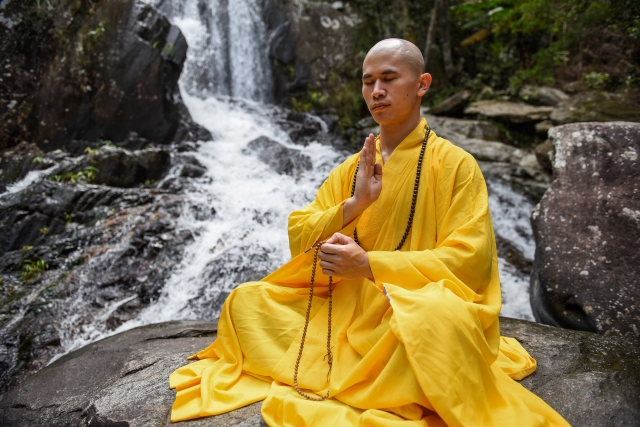
Buddhism and Shinto are the two religions with the largest number of believers in Japan. Even if you are not particularly religious, you probably have more than a little relationship with temples and shrines.
In my case, I go to shrines for prayers, including Hatsumode (New Year’s visits to shrines), and if there is a funeral of a family member, I go to the family temple.
However, there was a time when I could not give an immediate answer when asked about my religious affiliation, so I guess I can be said to be as close to a nonbeliever as possible.
I would like to at least gain knowledge of the ancestral sects, but without any opportunity, I will not be able to make progress in my studies.
Therefore, I decided to do some research as a means to deepen my understanding of Buddhism and Shinto (Shinto).

About Buddhism
Although most Japanese do not have a specific religion, Japan is considered a major Buddhist country, with approximately 75,000 temples and more than 300,000 Buddhist statues.
These numbers are an order of magnitude greater than those of any other Buddhist country.
According to the “Religion Yearbook” compiled by the Agency for Cultural Affairs and other sources, the Jodo and Jodo Shin sects and the Nichiren sects make up a large percentage of the Buddhist population in Japan today.
It is said that Buddhism was introduced to Japan in 552 or 538 during the Asuka Period. The year 538 is used in history textbooks.
After that, many sects were established in the Nara, Heian, and Kamakura periods, and they have continued to the present day. Let us look at them along the flow of time.

Buddhism in the Nara Period
During the Nara period (710-794), six sects, called Nanto Roku-shu (Six Sects of the Southern Capital) and Riku-shu (Six Schools of Buddhism), flourished. Each of these sects is as follows
- The Kusha sect … the sect that preached the sutras at the Great Buddha Opening Ceremony at Todaiji Temple in 752.
- Kegon sect … One of the Mahayana Buddhist sects based on the Kegon sutra.
- Sanlun Sect … One of the Mahayana Buddhist sects based on the “Sanlun” scriptures.
- Jōjitsu-shū … A sect attached to the Sang-ron sect, which studies the “Sang-ron”.
- Hosso sect … One of the Mahayana Buddhist sects
- The Ritsu sect … a sect that studies and practices the precepts
Buddhism in the Heian Period
Emperor Kammu sent Saicho and Kukai to China to study esoteric Buddhism. These two returned to Japan and spread the following sects
o Tendai sect … Saicho opened a temple on Mt.
o Shingon sect … Kukai opened a temple on Mt.
During this period, the belief in the Pure Land for the happiness of the afterlife became popular. Byodoin Temple in Uji was built as a symbol of the Paradise.
Buddhism in the Kamakura Period
In this period, the goal of Buddhism shifted from “national pacification” to “the salvation of the people” and the following sects emerged.
- Nichiren Shu (Nichiren Buddhism) … also called Hokke Shu, which chants the title “Nam-Myoho-Renge-Kyo” (Nam-Myoho-Renge-Kyo).
- Jodoshu … chanting the Buddhist prayer “Namu Amidabutsu” (Amitabha)
- Jodo Shinshu … preached the idea of “Akunin Shoki”.
- Yudo-nenbutsu sect … one of the sects of Jodoism
- Jishu … One of the sects of Jodoism
- Soto-shu … One of the Zen sects
- Rinzai-shu … one of the Zen sects
- Ōbaku … a branch of Zen Buddhism
About Shinto
Shinto is an ancient Japanese religion that is said to have been deeply involved in the formation of the national anthem. Here are some of its main characteristics
- It is a polytheistic religion that finds the existence of God in nature and all things in the forest.
- There is no clear founder or originator.
- It is based on “Kojiki” and “Nihonshoki” (the Chronicles of Japan) and other “Shinto scriptures.
- Places great importance on rituals, such as the worship of ancestral spirits.
- It tends to be more secularist than other religions.
Shinto can also be categorized as follows

Ko-shinto (ancient Shinto)
A concept created by nationalistic studies during the Edo period, sometimes described as “primitive religion”. The terms “pure Shinto” and “primitive Shinto” are similar.
The Shinto religious movement established in the early Meiji era (1868-1912) is also called kojindo.
Imperial Shinto
This is the Shinto religion of the Imperial Family, centered on the three halls of the Imperial Palace. It is also referred to as “kiyu-chu-saishi.
State Shinto
Shinto practiced from the Meiji Restoration to the end of World War II with the support of the state.
Shrine Shinto
A form of belief centered on shrines and practiced by udjiko, or those who revere the shrines.
Today, the term “Shinto” refers to shrine Shinto.

Folk Shinto
Folk Shinto is a form of belief practiced in the private sector and is also called Folk Shinto.
Combination and Separation of Buddhism and Shinto
Nowadays, celebrations and prayer events such as Shichi-Go-San and coming-of-age ceremonies are often held at shrines, while funerals and memorial services for ancestors are held at temples.
In other words, Shinto and Buddhist beliefs, customs, and events are combined. This is a remnant of the fact that Shintoism and Buddhism were generally combined before the Meiji Restoration.
For example, it was not unusual to see a torii gate inside a temple.
This mixture of Buddhism and Shintoism is known as “shimbutsu shuzo” or “shimbutsu konkou.
The Shinto/Buddhist syncretism that had been practiced for more than 1,000 years gradually collapsed in 1868 when the Meiji government issued a decree separating Buddhism from Shintoism.
Conclusion
- It is said that Buddhism was introduced to Japan during the Asuka period (710-794), and many sects were established during the Nara, Heian, and Kamakura periods (1192-1333).
- Shinto generally means shrine Shinto, but there are other classifications such as Koshinto, Imperial Shinto, State Shinto, and National Shinto.
- Even today, there are many vestiges of Shinto/Buddhist syncretism prior to the Meiji era.
Buddhism : Bukkyō came to Japan in the middle of the sixth B of bukkyō and subsequently won a victory in a century.
Supporters of the political power struggles of the time; built temples in every area under government patronage, and it spread throughout the country.
In the Kamakura Period (1185-1333), as many new leaders appeared and deepened their philosophy, bukkyō clarified its position of saving the weak. Zen Buddhism was brought to Japan in the Kamakura Period by priests who studied in China, and it flourished principally as the religion of samurai.
At present, a culture in Japan that has bukkyō as its backdrop has laid roots deeply in the people’s lives and, together with Shinto, forms the spiritual culture of the Japanese people. Also, even today new sects of bukkyō keep emerging and gaining believers.
Shinto, literally “the way of the gods,” is the Japanese religion S from ancient times, centering on the ideas of Japanese intimacy with nature and ancestor worship. All things on earth were brought forth and ruled over by the gods who reside throughout all nature.
Mountains and trees often become objects of worship, and Shrine archways and sacred Shinto ropes mark sacred areas. Ordinarily, when shrines are built, objects of worship in which a god or gods reside are enshrined.
Shinto constitutes the foundation of the sensibility of the Japanese people, but most present-day Japanese, rather than placing faith in Shinto, feel their cultural identity through it.
Shinto meanwhile supported the Emperor system in a religious sense, and even now its ancient customary practices remain as the religion of the Imperial Family.